Why Gemini Optimization Is Different From ChatGPT Optimization
Gemini and ChatGPT retrieve information differently at the architecture level. ChatGPT draws on training data and web browsing tools; Gemini grounds every response through Google Search and Google’s Knowledge Graph in real time. That difference means the signals that put a brand in ChatGPT’s answers are not the same as the signals that put it in Gemini’s — and treating them as interchangeable is how optimization budgets get wasted. The two engines require distinct strategies, and the divergence between them is often where the most actionable insight lives.
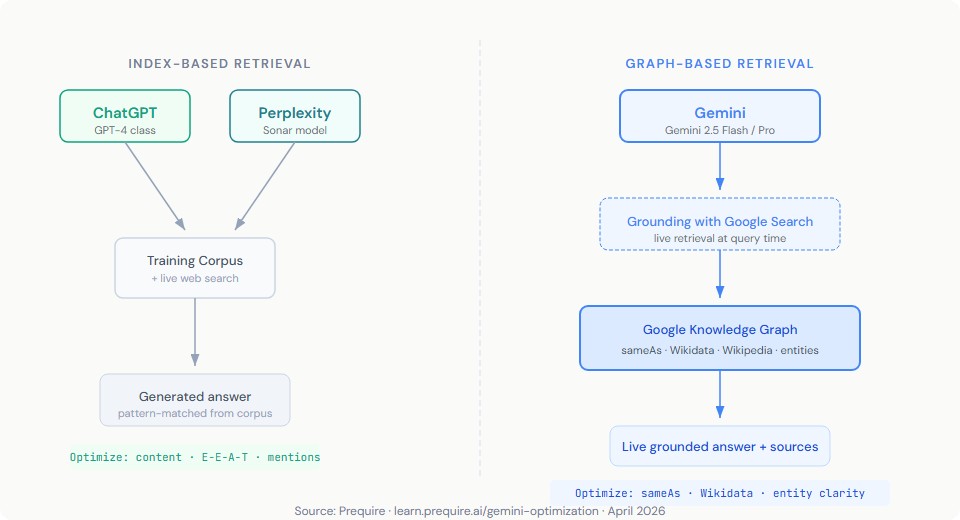
Diagram showing two retrieval paths: ChatGPT and Perplexity query a search index on the left; Gemini queries Google’s Knowledge Graph on the right, fed by Wikidata, Wikipedia, and sameAs cross-references.
Two Engines, Two Retrieval Architectures
When a user asks ChatGPT a question, the answer is assembled from two sources: the model’s training corpus (a large static snapshot of the web) and, when web tools are active, live search results. The model weighs both, but the training data is the dominant signal for most brand-level queries. How well a brand is represented in that training corpus — through publications, mentions, Wikipedia presence, and authoritative coverage — is the primary lever.
When a user asks Gemini the same question with Grounding with Google Search enabled, the model runs a live Google Search query first, retrieves the current top results, and constructs its answer from those sources. The training data is background context. The live retrieval is foreground signal. This makes Gemini’s citation behavior much closer to how Google Search rankings work — with the critical addition that the Knowledge Graph actively shapes which entities Google considers authoritative enough to cite.
Perplexity sits between them: live retrieval like Gemini, but from its own independent search index rather than Google’s. Perplexity cites web sources by default, making its behavior the most transparent of the three but also the most dependent on traditional web presence.
The Index vs. The Graph
The practical difference between index optimization and graph optimization is the unit you’re building equity in.
Index optimization — relevant for ChatGPT and Perplexity — builds equity in content. You publish high-quality, entity-rich material on authoritative domains. You earn mentions in publications that are likely to appear in training data or live search results. E-E-A-T signals matter. The model learns to associate your brand name with a cluster of relevant concepts.
Graph optimization — relevant for Gemini — builds equity in entity definition. You establish your organization as a clearly defined node in the Knowledge Graph. You do this through Organization schema with sameAs links, a Wikidata entry, a consistent name across authoritative sources, and ideally a Wikipedia presence. When Gemini grounds its response and Google retrieves sources about your brand, the KG entity definition shapes how confidently Google surfaces your brand in the answer.
“ChatGPT optimization feeds the index. Gemini optimization feeds the graph. Each engine has its own retrieval substrate — and its own API.”
This distinction matters especially for brands that are well-known in their industry but have thin public web presence. A brand with strong industry coverage but no Wikidata entry and inconsistent sameAs markup will underperform in Gemini relative to their actual market position. The KG doesn’t know they exist.
What Gemini’s Grounding Layer Means for Your Brand
Grounding with Google Search means Gemini’s answers are tied to the current state of Google’s index — not a static snapshot from when the model was trained. Three things follow from this:
- Your content freshness matters. A brand with recent, substantive content on its own domain and in authoritative third-party sources is more likely to be surfaced by Gemini’s live retrieval than a brand coasting on older coverage.
- Your structured data is read in real time. When Gemini retrieves your homepage or a key article about your brand, the Organization schema, sameAs links, and other structured markup are part of what it sees. A well-marked-up entity page gives the model confident signal about who you are.
- Entity consistency compounds. The more consistently your brand name, description, and sameAs identifiers appear across sources, the more clearly the Knowledge Graph resolves your entity. Inconsistency creates ambiguity that gets resolved against you.
What sameAs markup does specifically: The sameAs property on your Organization schema points to authoritative external identifiers — your Wikidata item, Wikipedia article, Crunchbase profile, LinkedIn company page. These cross-references help Google’s Knowledge Graph confirm that the entity it sees on your website is the same entity it sees mentioned in other authoritative sources. Prequire’s KG Readiness tool audits your sameAs coverage and flags missing links.
How Prequire’s Gemini Citation Monitor Works
Every Gemini query in Prequire’s Citation Monitor is sent with the google_search grounding tool enabled. This is the same grounding mechanism that a user experiences when asking Gemini a question in the Gemini interface. Without grounding, the API returns a training-data answer — which would not reflect live citations and would be misleading for optimization purposes. Prequire never uses ungrounded Gemini queries for citation data.
Each response returns:
- The generated text answer
- Grounding sources — the web URLs Gemini retrieved and cited
- Citation detected — whether your brand name appears in the answer text
- Sentiment — positive, neutral, or negative based on context around the brand mention
Screenshot: Prequire Citation Simulator showing all three engines with results
The Prequire Citation Simulator running a query against all three engines simultaneously. Each engine returns its own citation status, response text, and (for Gemini) grounding sources.
The Divergence View in Prequire’s Citation Monitor shows queries where Gemini and ChatGPT return different citation outcomes for the same brand and query. These divergences are where the index-vs-graph distinction shows up as actionable data — a query where ChatGPT cites you but Gemini doesn’t points directly at a graph optimization gap, and vice versa.
Screenshot: Prequire Divergence View showing queries with different citation outcomes across engines
The Divergence View highlights queries where citation outcomes differ across engines — a direct signal of where index and graph optimization gaps exist.
Featured Images Are AEO Surface Area Now
AI engines have started surfacing featured images alongside text citations in their answer interfaces. ChatGPT, Perplexity, and Gemini all do this in different ways and at different rates. The Open Graph image you set on a page isn’t just for Facebook and LinkedIn shares anymore — it’s part of how your brand appears inside AI-generated answers.
In practice this means the OG image is doing three jobs simultaneously: SEO work (it appears in link previews that drive click-through from search), social sharing work (it’s the image that renders when a page is shared on LinkedIn, X, or Slack), and AEO work (it’s the thumbnail that AI engines surface when they cite the page). A page without a unique, intentional OG image is leaving all three surfaces under-optimized.
What to actually do:
- Set a unique featured image on every atomic page — not just the homepage. A generic brand banner reused across 40 pages adds no signal. A page-specific image that visually communicates the topic does.
- Match the image to the page topic. If the page is about Gemini optimization, the image should read as “Gemini optimization” at a glance — not as “Prequire brand asset #3.”
- Test legibility at thumbnail size. AI engines and social platforms often render OG images at 200–300px wide. The headline text on the image should be readable at that size. Large Fraunces type on a clean background holds up; decorative flourishes and small text do not.
- Confirm the Article schema
imageproperty is populated. Yoast Premium does this automatically when a featured image is set — verify in the Schema tab preview after publishing.
“The image you set on a page is part of how that page appears when an AI engine cites you. Treat featured images as brand surface area for AEO, not just SEO.”
The discipline here is editorial restraint, not visual production. Type-driven images that put the page topic front and center outperform decorative images at both thumbnail legibility and brand recognition inside AI interfaces.
For a full treatment of featured image strategy as an AEO lever — including how to structure images for AI citation surfaces, optimal dimensions, and testing legibility at thumbnail size — see the forthcoming guide at /featured-images-aeo.
An Honest Timeline
Knowledge Graph optimization is slow. It is not slow because the work is hard — the markup changes and Wikidata entry are straightforward. It is slow because Google’s Knowledge Graph takes time to resolve new or updated entity signals, and because Gemini’s grounding reflects the current state of Google’s index, which itself has its own crawl and update cadence.
Rough expectations:
- Structured data changes are typically crawled and processed within 1–4 weeks. Validate in Google’s Rich Results Test immediately.
- Wikidata entries are indexed by Google within days to a few weeks, then feed into the Knowledge Graph over the following weeks to months.
- Measurable citation improvement in Gemini typically appears 60–180 days after a complete KG optimization sprint.
- ChatGPT citation changes are harder to time — partly a function of training data cycles. Live web browsing queries move faster, but ChatGPT uses browsing selectively.
Use Prequire’s Citation Monitor to establish a pre-optimization baseline before you start. Without a baseline, you can’t distinguish genuine improvement from query variance.
Where to Start
If you’re starting from scratch, the highest-leverage sequence for Gemini optimization is:
- Run Prequire’s KG Readiness scan — it audits your existing Organization schema, sameAs coverage, and Knowledge Graph entity signals.
- Implement the Organization schema with sameAs — prioritize Wikidata, Wikipedia (if eligible), LinkedIn company page, and Crunchbase.
- Create or improve your Wikidata entry — if your organization has no Wikidata item, create one. If one exists, verify the sameAs links are accurate and complete.
- Establish a sustained publishing cadence on authoritative domains — guest articles, press coverage, and industry publications that mention your brand with consistent naming.
- Set up Citation Monitor tracking — run weekly queries across all three engines to measure citation rate over time.
Start with a free scan. Run your site through scan.prequire.ai — no account required — to see your current AEO readiness score including KG signals. The full KG Readiness audit with fix recommendations is available in the Prequire dashboard.
Common Questions
Is Gemini optimization the same as Google SEO?
Related but not identical. Gemini uses Google’s Knowledge Graph and real-time Google Search grounding, so traditional SEO signals do matter. But Gemini cites at the answer level, not the ranking level. You can rank well in Google Search and still not appear in Gemini’s generated answers. The additional layer is entity clarity: sameAs markup, Wikidata presence, and consistent entity naming across authoritative sources.
Do I need Google Search Console access to optimize for Gemini?
No. Google Search Console shows traditional search performance. Gemini citation data is separate — Prequire’s Citation Monitor queries Gemini directly with grounding enabled and returns whether your brand is cited in the generated answer.
Does Prequire’s Citation Monitor use real Gemini with grounding?
Yes. All Gemini queries are sent with the google_search grounding tool enabled. Results reflect what a real user would see when asking Gemini a question — including real-time web retrieval. Ungrounded queries are not used for citation data.
How long does Gemini optimization take?
After implementing sameAs markup, a Wikidata entry, and a sustained authoritative publishing cadence, measurable citation improvement in Gemini typically takes 60–180 days. Establish a baseline before you start so the change is measurable.
Do featured images affect how AI engines cite my brand?
Yes. AI engines increasingly surface featured images alongside text citations. The OG image set on a page functions as brand surface area inside AI-generated answers — not just for social sharing. Set a unique, legible, type-driven OG image on every atomic page and confirm the Article schema image property is populated.
This page is reviewed quarterly. Provider behavior, grounding mechanics, and Knowledge Graph indexing timelines all change.
Flag outdated information and we’ll update within 48 hours.
Last reviewed: April 2026.